
"My" vs "Your" in User Interface Design
Collection vs Discovery
Every interface makes an implicit choice: Is it an extension of the user, or a separate entity speaking to them? This fundamental question shapes how you label items and how users understand what belongs to them. The difference between “my” and “your” is more than grammatical—it’s about ownership and agency.
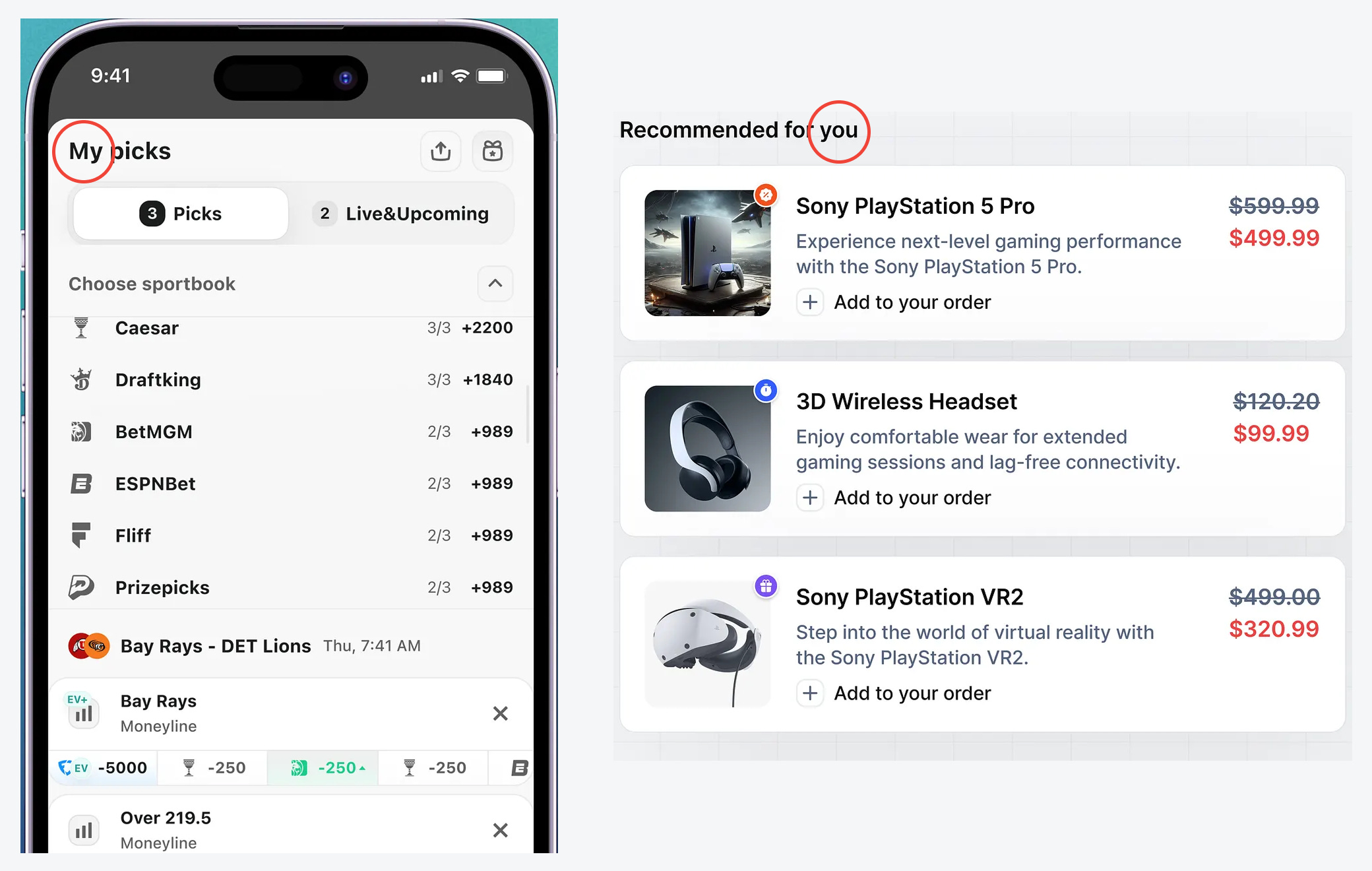
“My” signals absolute possession. When users see “My Picks” or “My Photos,” they understand these are spaces they control and have personalized. The first-person perspective puts them in the driver’s seat.
“Your” signals contextual relevance. “Your Recommendations” or “Recommended for You” indicates content the system has curated for them. The second-person perspective positions the interface as a helpful assistant presenting personalized selections.
Personalized vs. Customized
Use “my” for items users create, modify, or control directly—such as their playlists, saved items, custom settings, and uploaded files. These reflect deliberate user action and ownership.
Use “your” for items the system generates or tailors based on user data—recommendations, location-based suggestions, algorithmic feeds, account summaries. These are relevant to the user but system-created.

Consider an events platform: “Events Near You” works for algorithmically suggested events based on location. “My Events” works for the user’s saved or created events. The distinction helps users quickly differentiate between discovery (what the system found) and collection (what they’ve chosen).
What About Skipping Both?
Sometimes neither is necessary—”Dashboard,” “Settings,” and “Library” work perfectly well when the context is clear. But in cases where users need to quickly distinguish personal content from general content, the possessive becomes a critical wayfinding cue.
Without “my,” users struggle to identify their owned content among site-wide options. Without “your,” they can’t tell whether the content is universally displayed or personally tailored, which reduces perceived value and relevance.
The Bottom Line
Possessive pronouns aren’t just politeness, but rather functional signposts. “My” empowers users by acknowledging their ownership. “Your” personalizes the experience by acknowledging the system’s awareness of them. Choose deliberately, stay consistent, and users will navigate with confidence.